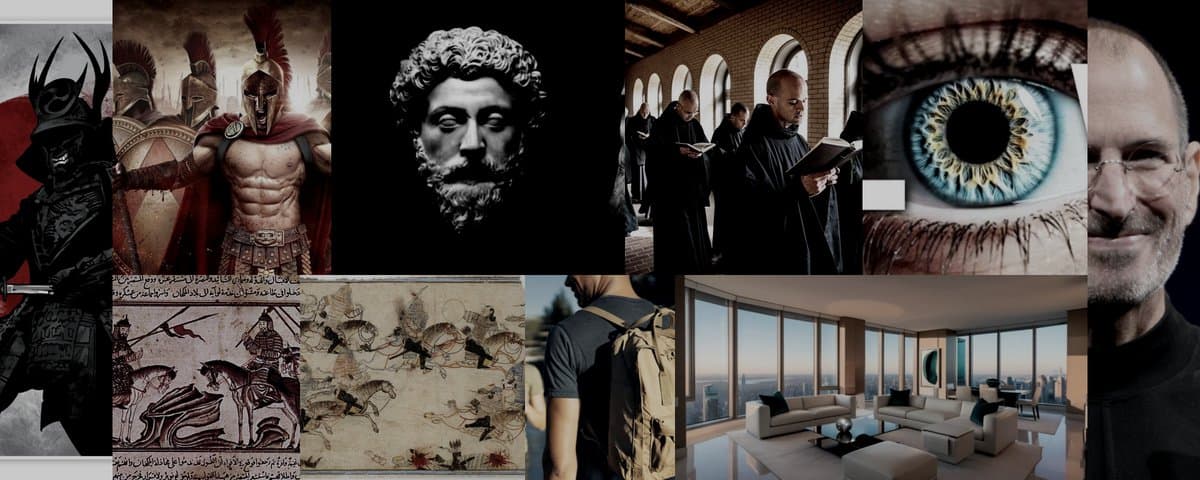
Throughout history, the world's top performers have known something most of us don't.
From Spartan warriors to modern billionaires, there's something they do that powers their success.
It's not strength, status, money, or even genius.
It's something you can tap into immediately to free up your time, upgrade your cognition, and, as a bonus, it's one of the only performance hacks that will save you money.
*I'm Rian Doris. I've trained thousands of professionals — including teams at Audi, Facebook, and the US Air Force — on how to increase productivity and access flow state on demand.
Get a free PDF summary of this article in the comments below.
Estimated reading time: 15 minutes*
I. THE PATTERN ACROSS HISTORY
A subtle thread has woven its way through the lives of the world's highest performers.
It's a pattern that has shaped the destinies of warriors, artists, Olympians, surfers, and business leaders. While often overlooked, it played a key role in their remarkable achievements.
The Spartans
Take the legendary Spartans, whose rigorous military discipline and frugal lifestyle were the bedrock of their strength.
They owned little, focusing instead on the mastery of their martial skills.
With minimal resources, a few hundred Spartans held off thousands of Persian soldiers at Thermopylae, demonstrating exceptional military efficiency and endurance.
The Stoics
Consider Stoics like Seneca and Marcus Aurelius, who eschewed the trappings of wealth in favor of a life centered around inner virtue and simplicity.
Their philosophy allowed them to maintain composure and effective decision-making even in the face of extreme stress and adversity.
Aurelius successfully led Rome through multiple crises, including war and plague, guided by his Stoic principles. Principles that have survived since 300 BCE.
The Samurai
In the East, the Samurai of feudal Japan adhered to bushido, a code that celebrated frugality and discipline.
Their lives, stripped of excess, were a testament to the power of focus and intention.
Consider the Samurai Miyamoto Musashi.
Because dueling was so high-stakes, often leading to death or severe injury, most samurai might have only participated in a handful of duels throughout their lifetime.
Yet Miyamoto won over 60 duels.
The Monks
Even in monastic traditions worldwide, from Christian monks to Buddhist hermits, we find a similar pattern: lives of simplicity, dedicated to higher pursuits.
Thomas Aquinas' "Summa Theologica" stands out for its comprehensive analysis and synthesis of Christian theology, accomplished in the solitude of a monastic environment.
This contrasts sharply with the typical scholarly output of the time, which was often less extensive and done in collaboration with others.
Over 700 years later, "Summa Theologica" remains a cornerstone text studied by theologians and philosophers.
The Mongols
Then there's the Mongols.
In the 13th century, Genghis Khan's Mongol Empire rapidly expanded to cover Eastern Europe, the Sea of Japan, Central Asia, the Middle East, and China.
The Mongols were nomads, riding horses before they could even walk.
They could fire arrows with precision while riding at full gallop.
They owned little more than weapons, food, and portable yurt homes.
This allowed them to strike enemies like lightning and then disappear before their targets even knew what was happening.
Eventually forming the largest land empire of the time, four times the size of Rome's.
The Unifying Pattern
These examples might suggest a rejection of material wealth or a life of asceticism.
But that's not quite it. It's something more profound, more specific.
Across wildly differing contexts and cultures, there's a unifying pattern among these peak performers:
The intentional prioritization of what’s most valued and the removal of everything that distracts from it.
It's not about deprivation. It's about radically excluding everything except the essential.
This philosophy is called minimalism.
Contrast this approach with what the average knowledge worker deals with every day.
You probably know how this goes...
II. THE COST OF OWNERSHIP
You go to get dressed in the morning, searching for your favorite shirt, but it's lost in the chaos of your cluttered closet.
Clothes pile upon clothes, some rarely worn, yet they all jostle for space and attention.
You check the laundry room and pull your jeans out of the dryer, only to discover they've shrunk.
As you pack your bag for work, trying to find your charger, you rummage through drawers, moving aside gadgets you don't use, cables you don't recognize, and miscellaneous items that somehow found their way there.
You go to make coffee, forgetting that you lent the electric kettle to a friend.
A week later, when they finally give it back, the item is dented...
You head toward the door to commute to work and spot a pile of boxes.
Stuff you ordered online on impulse. Each unopened box is a task pending, a decision delayed.
You slice one open with your keys, but see the item isn’t as expected, and has to be returned...
Running behind schedule, as you open the garage, you accidentally bang your watch against a wall, leaving it with a scratch.
For a moment, everything stops.
Your mind fixates on the scratch, and without realizing it, you've just spent the first few minutes of your day absorbed in this single object. And for the next thirty minutes, you can't stop thinking about it.
You walk to your car, eyeing a few surfboards in the garage that just hang there and collect dust, subtly gnawing at you, a reminder of previous passions and time poorly spent.
And on the way to work, instead of priming yourself for the day ahead, you're still thinking about the damn scratch on your watch...
“Thinking about things" is the real cost of ownership.
Possessions get lost, or damaged, or have to be returned or maintained, or become an obstacle between you and some other, more important target of your attention.
III. THE SCIENCE OF COGNITIVE LOAD
John Sweller, psychologist at the University of New South Wales, spent his career understanding how our cognitive system handles information.
His research unveiled a pivotal concept that would become central to understanding mental processes, problem-solving, and performance.
That concept is cognitive load.
Cognitive load refers to the amount of information we're holding in working memory at any given time.
Your Brain Under Heavy Load
Think of your brain like a computer.
You know when you're using your computer, and it starts to stall?
You're writing an email, and the text appears several seconds after you type it.
Websites take longer to load.
You get the dreaded "pinwheel of death."
This happens to our brains too.
Figuratively, your brain has a finite amount of RAM.
That's your working memory.
The higher the cognitive load, the more RAM is used up. Your brain gets slower, your ability to learn plummets, and your attention gets whipsawed.
You're left with fewer attentional resources (focus, decision-making, creativity) to devote to your priorities.
What's Happening Neurologically
The brain contains roughly 86 billion neurons, each capable of forming thousands of synaptic connections.
But there's a hard limit to how many can fire simultaneously — constraining how much information you can process at any given moment.
Think of it as a vast road network.
Neurotransmitters like glutamate (accelerator) and GABA (brake) are the vehicles moving along neural pathways.
Too much traffic, and everything jams.
The prefrontal cortex — your cognitive command center for working memory, focus, and decision-making — has finite capacity.
Overload it with information, and efficiency collapses. You struggle to concentrate, remember, and decide.
Then there's energy.
The brain is 2% of your body mass but consumes 20% of its energy.
There's a ceiling to how much processing it can sustain before performance degrades.
These constraints likely served an evolutionary purpose: quickly processing a few relevant signals (threats, resources) was more adaptive than slowly processing everything.
The result is a cognitive load threshold.
Exceed it, and your mental circuitry starts to falter — like a computer choking on too many open programs.
Here's the problem:
Every misplaced shirt, every scratched watch, every borrowed item not returned — these unnecessarily spike cognitive load.
A constant background of noise, irrelevant to your goals, overloading your attention.
IV. POSSESSIONS AND FLOW STATE
On the flip side, the lower the cognitive load, the easier it is to get into a flow state.
That's the optimal state of consciousness where we feel and function at our best.
Flow can only arise when all of our attention is focused on the present moment.
That's what flow triggers do:
Neurologically, they increase focusing chemicals (such as dopamine and norepinephrine) or they reduce cognitive load.
But here's the thing... possessions can actively block this from happening.
Possessions possess the mind, literally, increasing our cognitive load to such an extent that it suppresses flow state.
Here's how to think about it:
For every possession you own, some increment of your attention is captured.
Each possession represents a piece of information the brain needs to process, requiring attentional resources for recognition, categorization, and decision-making, thereby contributing to the cognitive load.
A single unit of attention might only equate to 10 seconds. A negligible sliver of your time.
For example, a pair of pants that cost you $100 might only capture 10 seconds of your daily attention.
Thoughts about wearing them, cleaning them, or where you put them.
But some objects consume more cognitive load than others.
Based on the cost of the possession, its irreplaceability, how much you identify with it, its sentimental value or emotional context, resale value, maintenance requirements, and a whole host of other variables.
The Attention Math
A new iPad, with its charging, maintenance, and usage, could take up a couple of minutes of your day.
A Rolex could demand 10 minutes daily. Admiring it, caring for it, or even worrying about its safety.
A new house or boat represents a major investment in terms of attention, possibly taking up to an hour each day in maintenance, security, or simply appreciating its value.
Let's calculate the total units of attention they can accumulate over a day:
- Pants: 10 seconds
- iPad: 2 minutes (120 seconds)
- Rolex: 10 minutes (600 seconds)
- Mansion/Boat: 1 hour (3,600 seconds)
Total daily attention: 4,330 seconds or about 1.2 hours per day.
In a year, this adds up to a staggering 300+ hours, or approximately 14 days spent just attending to these possessions. That's half a month of continuous, waking attention dedicated solely to a handful of items.
But here's the thing:
The average knowledge worker has way more possessions than a pair of pants, an iPad, a watch, and a boat or house.
From clothing, toys, household items, furniture, electronics, personal care products, books, old photos, musical instruments...
The average number of possessions in a typical American household is often cited as 300,000 items.
When Possessions Threaten Identity
On the extreme end, this "thinking about things" turns material possessions into extensions of our identity and self-expression.
This can turn any threat to our possessions into a threat to our very selves.
When this happens, possessions become even more destructive to our attention.
As the godfather of flow, Mihaly Csikszentmihalyi put it:
*"The problem is that the more the ego becomes identified with symbols outside the self the more vulnerable it becomes... the sudden loss of one's possessions results in a 'shrinkage of our personality, a partial conversion of ourselves to nothingness.' To prevent its annihilation, the ego forces us to be constantly on the watch for anything that might threaten the symbols on which it relies... which distorts reality so as to make it congruent with the needs of the ego."*
V. HOW POSSESSIONS KILL CREATIVITY
This increase in cognitive load doesn't just zap away your time and hijack the resources you need for productivity and flow.
It also clogs up your creativity, by degrading the quality of your rumination.
Rumination occurs courtesy of the Default Mode Network in the brain, which is active during your idle moments.
Think of your Default Mode Network (DMN) as a garden where you harvest your best ideas. Each possession you own is like a weed in this garden.
Every time you get a new possession, it's like planting another weed in this garden.
Every moment spent managing or worrying about this item allows the weed to spread.
Gradually, these weeds overtake the garden, leaving little space for the flowers and plants of creative thought, problem-solving, and personal reflection.
Put simply: Possessions possess the mind.
From a little to a lot. You're juggling not just the demands of the present but the accumulated demands of every item you own.
As Csikszentmihalyi continued:
*"...the acquisition and maintenance of objects can easily fill up a person's life, until there is no time to do anything else, not even to use the things that are exhausting all of one's psychic energy. When such a pass is reached, the adaptive value of objects is reversed; instead of liberating psychic activity, the things bind it to useless tasks. The former tool turns its master into its slave."*
Minimalism drives flow because you reduce cognitive load and free up mental capacity.
And flow drives minimalism.
The more flow you get, the more you do the work for its own sake, so the less stuff you want, the more work you do, and the less stuff becomes an obstacle to the work.
In short, minimalism leads to maximalism in performance.
VIII. HOW TO APPLY MINIMALISM FOR FLOW
So, how do you actually do this?
How do you go from a possession maximalist and a performance minimalist to a performance maximalist and a possession minimalist?
For flow and peak performance, you don't have to go full minimalist. Instead, you can minimize where it counts the most and get the bulk of the benefit.
There are three ways:
Step 1: Determine Your Minimalist Sweet Spot
The first step is determining where you fall on the spectrum — based on your values and goals.
One end: all-in professionally, driven to succeed to an extreme degree. The other: willing to trade some professional edge for personal pleasure through possessions.
Which tier fits you?
Tier 1: Aggressive Minimalism
For three years, my entire life fit into a single black backpack.
Laptop, one pair of jeans, three shirts, a week's worth of underwear, flip flops, jacket.
Whether in Ireland, Barcelona, or Mexico City, my mornings were seamless — wake up and dive straight into work or adventure.
At this level, you optimize for performance, productivity, and flow above all else. You own only what's essential for your work and goals.
Everything is a tool, a means to an end — never an end in itself.
You're an archer with a quiver containing only the arrows needed to hit the target. No more, no less.
Tier 2: Tempered Minimalism
Living in one place means owning more — furniture, appliances, plants. This tier balances minimalism with practical living.
Your possessions are chosen for both comfort and flow, but flow wins when they conflict. A small, efficiently organized home.
Multi-functional furniture. A few well-loved items that enhance daily life — a quality coffee machine, a comfortable reading chair.
You're a Swiss Army knife: compact, efficient, versatile.
Most tools are essential; a few are nice-to-haves.
Tier 3: Mild Minimalism
You're not a minimalist, not a maximalist — but you're conscious about possessions and their cognitive cost.
Whether for family, health, hobbies, or roots, you own more than the essentials.
But each item is chosen with care.
You enjoy your possessions, and they add value — while staying aware of their impact on mental space.
You're a curated gallery.
Each piece is displayed with intention, contributing to the overall experience.
Winston Churchill landed here.
Deep appreciation for art, literature, and luxury — but deliberate about what he owned.
Chartwell, his home, was filled with books, paintings, and artifacts reflecting his interests in history, strategy, and culture.
Possessions chosen not just for utility but for inspiration.
*He acknowledged: "All the great things are simple."*
Choosing Your Level
There's no ideal tier — it depends on your values and goals. People vary in how much cognitive load possessions create.
But remember this:
You have a finite amount of cognitive load you can handle and only so many units of attention to allocate.
Do you want that attention available for personal use or professional use?
There's no right answer. But the question acknowledges the cost of ownership.
Step 2: Do a Possession Purge
After living as a minimalist nomad for three years, I settled down in the house of my dreams in LA.
Before I knew it, everything changed.
I filled my sprawling house with gadgets and supplements, stylish clothes spilling out of a walk-in closet.
Now, my mornings involved disentangling a knotted pile of chargers to find the one iPhone cord with juice, rifling through a sea of predominantly right headphones to find the working left one, and digging through a wardrobe far too extensive for the climate.
By the time I shuffled to my home office and assessed which of the four chairs best elicits productivity, my mind was foggy and fatigued by the countless micro-decisions.
My home base was now LA, so it made sense I would now have more possessions instead of living out of my backpack.
But things had gotten out of hand.
I had to rebalance things and get into the Tier 2 minimalist sweet spot.
So, I ran a possession purge: I removed absolutely everything from my room except for the bed and couch.
From there, I kept the 15% that I actually needed and had someone get rid of the rest.
And that's what you want to do at this step.
How to Run the Purge
First off, set aside one full day for the possession purge.
It can take less time, but you probably want at least one day to do this. What you don't want is for this to sprawl out into weeks and weeks. You are making an event of it and getting the job done.
You want to wake up in the morning on one level of the minimalist spectrum, say Tier 3, and go to bed on a higher level, such as Tier 1 or 2.
To kick off the possession purge, gather up everything that you own. Put everything in one big room so you can see it all. You're going to be putting each item in one of two piles: keep or cut.
In the cut pile, you can decide whether to donate/gift, trash/recycle, or sell it.
But the key is that you are removing it from your life.
You'll take each item or category of item and, depending on your minimalism sweet spot, ask a simple question, and assign that item to one of the two piles accordingly.
For Aggressive Minimalists
If you're aggressive and know you need to go all-in with your profession for peak performance, then the next part is simple:
Just get rid of everything except whatever you need to advance your craft and stay healthy.
*The filter for each possession is the question: Is this a tool that advances my craft and professional pursuit?***
If the answer is "yes," then keep it.
If it's "no," then cut it: sell it, donate it, give it away, recycle it, trash it.
Put it out on the curb to be collected, or put it all in the garage and invite all of your social media friends to swing by in the next 48 hours and take whatever they want.
This is the fast and fun way to do a possession purge and immediately reclaim a significant amount of cognition.
For example, if you're a Brazilian jiu-jitsu martial artist, maybe you keep your gi, your supplements, and foam rollers for recovery.
If you're an entrepreneur, you keep your laptop, charging cables, and some clothes for meetings.
If you're an artist, you have your paints, canvases, and brushes.
Every other item should be aggressively filtered: Is this a tool that advances my craft and professional pursuit?
For Less Aggressive Minimalists
The filtering criteria for aggressive minimalists are simple. If you are less extreme, the filter question is different.
*With each possession, ask: "What am I assuming I'll get from this... and is that worth the cost of ownership?"***
Meaning, relative to the cognitive and performance trade-off... is it worth the cost of ownership?
You've now been given a sense of what the cognitive, creative, and performance cost of ownership is.
*So another way of conceiving the question is, "Do I love this more than the potential cost of my attention and professional progress?"*
The answer is always binary: "yes" or "no."
As you ask this question, a whole host of subquestions will arise in your mind, based on your own values and criteria.
You'll weigh the item's sentimental value, memories and emotional associations (both good and bad), its future utility, and a slew of other considerations.
Maybe you have items that used to belong to a loved one who passed away, so the item has both positive and negative emotional associations.
Maybe you have cables and adapters that you are likely to use at some point in the future, and you value making use of what you own over the long haul more than you value purging it.
These secondary considerations are useful, and revealing: the more considerations that come to mind, the higher the cost of ownership.
It signifies a certain "weight" to the possession, adding to your cognitive load. If it's not an obvious "yes," then it's a cognitive or emotional "possession," staking some claim to your attention and emotions.
This isn't inherently a negative thing; it's just something to be aware of as you scrutinize each item and ask, "Is this worth the cost of ownership?"
When you subject every possession to the filtering questions, the very act of doing the filtering gives you a sense of what the cognitive cost of ownership is.
It takes time to do this.
And often, as we live our lives, we end up accumulating a lot of physical clutter that translates to mental clutter.
This is a chance to purge the stress, hassle, and cognitive burden of your possessions and put yourself in the sweet spot for optimal performance.
Step 3: Maintaining Minimalism
You got yourself into the sweet spot you prefer... now you need a simple way to maintain it.
This is how you make sure you don't end up imbalanced, like I did after a few years of living in LA.
Thankfully, maintenance is easier and takes less time than the possession purge.
All that's required is to have a heuristic for onboarding new possessions.
For Performance Maximalists
If you're a performance maximalist and possessions minimalist, the heuristic here is simple:
Get rid of something for everything you bring in.
Avoid accumulation, and you'll avoid ever losing the minimalism sweet spot.
For Less Extreme Minimalists
If you're less extreme with your minimalism, the key is to minimize the stuff creeping in.
Create an algorithm for determining in advance whether something is worth the cost of ownership.
Remember that one of the main things humans crave is the neurochemical reward, the squirt of dopamine, often called "shopper's high."
Mechanistically, it's not the item itself that we want; it's the temporary neurochemical reward that it brings us.
And of course, given the temporary nature of that neurochemical reward, we can pause and consider if there are alternative means for receiving such a reward, without adding to our cognitive load brought on by possessions.
So, a filtering question could be: "Is acquiring this new possession worth the temporary neurochemical reward it brings?"
Psychologist Mihaly Csikszentmihalyi made a useful distinction between pleasure, which is often what we're chasing when we purchase anything beyond the essentials, and the enjoyment we get from meaningful engagement in work and flow.
Pleasure doesn't lead to increased skills, growth, or a better future.
Enjoyment, through flow state, does.
The Annual Purge Backup
Suppose you find yourself slipping from using the heuristic of either removing a possession before adding or weighing the cost of ownership against the temporary squirt of neurochemicals. In that case, there's a backup: Run an annual purge.
This is where you repeat the process of gathering all of your possessions and subjecting them to the question:
* "Is this a tool that advances my professional pursuit?" Or "Is this worth the cost of ownership?"*
This keeps you conscious of the way possessions possess the mind, and how your environment determines how you live and who you'll become.
As Csikszentmihalyi put it:
* "The organization of the household can be seen as a pattern of attention and intention made concrete in the artifacts and the ambiance they create; a pattern that, in turn, channels the psychic energy of the inhabitants. The household objectively represents what the self is in terms of what things psychic energy has been invested in — what we consider significant to possess. If examined closely, it can reveal the patterns of attention that help to structure our everyday consciousness."*
IX. WHAT CHANGES NOW
Minimalism is a practice used by the highest performers across humanity's tenure to elevate peak performance and flow.
And you can adopt it simply by getting rid of most of what you own, finding a sweet spot for balanced minimalism, and then reworking your relationship to possessions long-term.
The choice is yours.
Continue the accumulation's downward spiral, or walk the focused road of less.
*I'm Rian Doris. I've trained thousands of professionals — including teams at Audi, Facebook, and the US Air Force — on how to increase productivity and access flow state on demand. *
*Get a free PDF summary of this article in the comments below.*