*“AI will replace 50% of white-collar jobs in the next 2-5 years.”
- Dario Amodei, CEO of Anthropic*
I can’t help but notice how good AI has become.
And I know, many people are sick of hearing this to the point where they started tuning out and not paying attention to AI anymore.
But things are now different.
Software engineers outsource their entire work to AI. Normal, everyday people are building million-dollar tech startup companies without knowing how to code. Accountants are getting replaced by AI.
This opens up the questions: “What do we do then?”
If AI can write any code, create any software, solve any math problem, and create any art, what do we do then?
How will the structure of our society (that was built around work and the identity we adopt through our work) change?
How will humans find meaning in their lives when they don’t have anything to do?
After all, most people derive their worth and sense of identity from the work they do.
And that is what I wanna share with you today.
Why AI is different now compared to 3-4 years ago (and why you need to start paying attention to it).
The jobs that are currently getting replaced (we’re talking about white-collar jobs that we thought were impossible to get replaced but are the first ones to go). And how high-income skills are no longer valuable.
Then I’ll share with you the 6 domains that humans use to generate meaning in their lives.
Lastly, we’ll end with 4 skills that you can learn to future-proof yourself.
Let’s dive in.
Why AI is different now
The first time we got to use AI was back in 2021-2022.
I was still in college and ChatGPT just came out.
It was good, but nothing crazy. It was mostly a gimmick. It would hallucinate, make mistakes, and overall, it just wasn’t that smart (at least the average user didn’t know how to make it work).
But in the world of AI, 4 years is ancient.
To truly understand this, you need to understand just how much progress we have made in the last few years alone.
- 2018: GPT-1 basic language tasks
- 2020: GPT-3 high school level reasoning
- 2022: GPT-4 90th percentile on SAT, LSAT, and medical exams.
- 2025: GPT-5 got the IMO Gold Medal
But what’s scary is something that happened in Feb of 2026. OpenAI, the company that created ChatGPT, has released its newest model, ChatGPT 5.3 Codex, and when they released it, this is what they said:
This is the first time we saw an AI model create itself.
Once AI can start creating a newer, better version of itself, that's where we enter exponential growth. Intelligence no longer becomes an advantage. Because everyone will have access to the same models. And once everyone has the same advantage, it no longer becomes an advantage.
Jensen Huang predicted this back in 2024:
*“The future of coding language will be our native language.”
- Jensen Huang, CEO of Nvidia*
But if AI is so smart, then why should you learn how to code? Why can’t you code with just plain English, Chinese, or German, or whatever language you speak?
With how smart AI models have become that’s finally possible.
Now, software engineers outsource their entire work to AI. And it makes sense why they would do it.
AI can write code faster than humans. It makes fewer mistakes. It remembers a lot more things than software engineers. The cost of producing code is now cheap.
This is exactly what happened now with the coding industry. We’re seeing a boom in “Vibe Coders”, people who know nothing about coding or tech, but they have an idea for a product and speak to AI in plain English about their idea and the AI handles all the technical parts.
The Vibe Coding industry is now $3 billion and experts predict that it will reach $30 billion in the next 6 years.
Coding as a skill is no longer valuable. A skill that is far more valuable now is marketing. Getting your product in front of more people. Tech companies are now shifting their budget away from the engineering departments and giving more money to marketing and PR. Because their bottleneck is no longer a product problem, they now need more customers.
Hell, I’m using AI to help me with my thesis, I’m talking about finding key points, spotting insights that I’ve missed, and even writing my code.
Even my last thread was written 80% by AI.
I had the idea and the general outline in my head when I was on a run. Gave AI simple instructions on what to do and boom. A first draft written in 2 minutes. Then I spent another 30 minutes editing it (but that’s just because I’m a perfectionist).
The idea of “will AI replace humans?” isn’t even a question anymore. It’s a matter of *how fast AI will replace humans.*
What’s happening with AI isn’t something new
*“You won’t lose your job to AI, you’ll lose your job to somebody who uses AI.”
- Jensen Huang, CEO of Nvidia*
What’s happening now isn’t anything new. It’s always been part of our history.
When the printing press was invented, monastic scribers (people who were highly skilled and whose entire job was to hand-copy books to preserve them) were the first ones to be replaced. These were highly trained people who spent years mastering their skills. It was also a very prestigious job. But when the printing press became a thing, they were no longer needed. All of a sudden, you can now copy in a matter of seconds.
The same thing happened with the mechanical reaper, thresher, and plow. They dramatically reduced the number of workers on the farm. What required dozens of people could now be done by a handful.
Later, we saw a similar thing happen with industrial work. Humans were replaced by machines that never ask for a day off, a pay raise, or complain about too much work.
And now it’s happening with AI. People are getting replaced by technology.
- Customer service & call center agents: AI chatbots handle these at a fraction of the cost
- Data entry & administrative roles: highly repetitive, easy to automate
- Paralegals & legal researchers: AI can review documents and case law faster and cheaper
- Junior analysts & financial roles: pattern recognition and report generation are AI strengths
- Radiologists & medical diagnosticians: AI already matches or exceeds human accuracy in reading scans
- Copywriters & content creators: generative AI produces text, images, and video at scale
Technology has (and always will) replace humans. It’s part of our evolution. As long as there are tasks and things we don’t want to do, humans will find a way to outsource them or automate them.
That’s what we do. We are problem-solvers to our core.
One thing I learned when I was researching about this topic is humans are f*cking resilient.
Sure, 50% of the white-collar jobs are getting replaced. But we’ve always found a way to get past this trouble in the past and nothing will be different from now.
If anything, technology only enables those who have high sovereignty.
People who set their own goals, solve their own problems, and don’t rely on others to give them what they want.
AI will help accelerate the progress these highly sovereign individuals make. AI will help them increase productivity, create more, think harder, take on more interesting and creative challenges that weren’t possible before.
We’re moving away from technical work.
Being a specialist is meaningless now.
The future of society when work is meaningless
There’s a massive flaw in the AI story.
A quick recap on the AI story that’s currently being played out:
- Humans build technology
- Technology makes our work easy
- Humans have more time to build better technology
- Eventually, humans built AI
- AI starts doing low-level admin work
- AI gets smart enough to do high-level work
- Humans get replaced with AI
- AI does all the work, humans have no jobs
That’s basically how the story ends.
Humans have no jobs and that’s it.
But if you think about it, the story stops at the most important part.
What happens *after humans get replaced?* How will we survive? How will countries and economies flourish?
Because after all, the reason why our economies continue to grow is because we have money to spend. But if we have no jobs, how can we earn money?
My prediction is that we will see 2 groups.
Group 1: Sovereign individuals who set their own goals and create all the wealth in societies.
Group 2: Ordinary people who will rely on the universal basic income that governments provide
The problem is, Group 2 has no agency. They don’t have a say in how they live their lives, the work they do, or the goals they achieve. Because they can’t rely on themselves. Being in group 2 sounds amazing until you realize that this system (universal basic income) doesn’t actually serve your best interest. Because you’re not the one funding it, Group 1 is the one funding it (they’re paying the most in taxes).
If your entire life is dependent on someone else, then that person has the say in what you do and must obey.
If you don’t set your own goal today, you will be assigned new ones in the future and you’ll believe them.
If you do not solve your own problems, you will be told what problems to solve.
If you do not set your own routine, you will be assigned one.
If you don’t know what you want to do, someone else will come along and tell you what to do.
The world is an efficient place.
There is no place for “useless” people.
If you think you are useless, other people will come and make you useful to them.
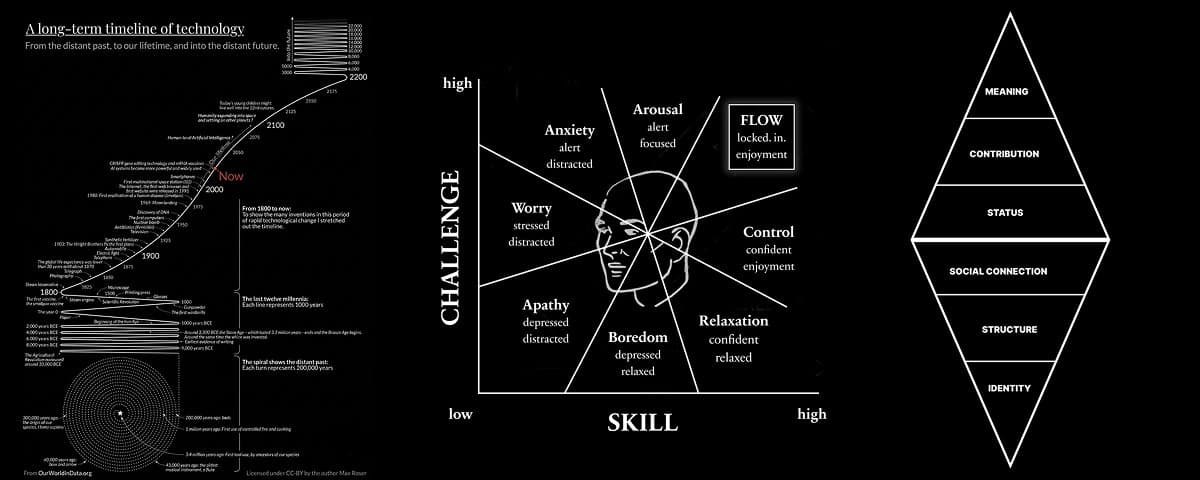
The 6 stages of human's hierarchical needs
Traditional jobs aren’t all bad.
For the majority of people, a normal 9-5 is the most logical path. It nails all 6 domains of life that are required to live a good life.
1) Identity
When you ask someone, “Who are you?” or “What do you do?” almost everyone will reply with what they do for a living.
Engineer, artist, doctor, lawyer, accountant.
Their identity is rooted in their jobs. Work is now the core of how you see yourself and how society sees you.
2) Structure
This saddens me a bit, but work also gives people a routine to follow. Work from 9-5. 5 days a week. 2 days rest. Repeat for the next 40 years. Everyone has a routine. For most, it’s the traditional life I just described. For others, their routine is having no routine. Nonetheless, a routine helps organize your mind, life, and goals. It structures your day in a sequential order, something to always look forward to (or do). But the problem is that most people don’t enjoy the routine they were assigned (from their jobs). Which is why when they retire, they find it psychologically hard to do nothing. If you don’t create a routine you love, you will be assigned one.
3) Social Connection
Work is where most people find their tribes. When you were still in school, you had a ton of friends. But when you become an adult, making friends becomes extremely hard. The reason is because when forming friendships, you need to be in close proximity with the same people consistently. In school, you were forced to be around your classmates for 8 hours. In a way, you were “forced” to form connections -- this is also why run clubs are becoming so popular for dating. Every week, you go and run with the same group of people, and over time, you’ll form a connection with them. The same thing happens with your workplace.
4) Status
Status is important because it determines your place within your social hierarchy.
We used status back when we were hunter-gatherers.
Who is Monkey #1 and who is Monkey #2? Who is the leader and who are the followers?
The higher your status is, the more opportunities, resources, protection, and influence you have.
Your brain responds to status as it is a physical thing. That means if someone attacks your status (says you’re not as good-looking or smart as they are), your brain sees that as a physical threat.
5) Contribution
Everyone loves to feel like they are useful and respected within their society.
*(We’re still just monkeys trying to fit in our tribes)*.
When we contribute, it gives us a sense that we have something valuable to provide to the world. When you look at people who are depressed or miserable, you’ll almost always find that they don’t feel like they’re useful or they have a place in the world.
This is why work is so valuable. It makes people who don’t feel useful, useful. It gives them something to focus on and strive for.
It provides a goal for them.
6) Meaning
I discovered this as I was building my brand.
Meaning is the next step in evolution after contribution. You go from “I can be useful” to “This is what I am meant to do”.
Meaning is a feeling that you have inside you that is constantly pushing you towards a bigger goal you have. This goal is usually to serve others.
Your meaning is the thing you want to be remembered for. It’s the fingerprint you want to leave in this world.
For me, my meaning in life comes from helping people improve their lives. Usually, that’s by helping them start a one-person business. From my experience and life, I realized that business is the best vehicle for self-improvement. You’re forced to grow, rewire your mind, uncover and overcome self-limiting beliefs, and know that every problem you have in your business is a direct result of a problem in your personal life.
The 3 drivers to generate meaning in your life
In the future, when AI does everything we want it to do, what’s the point of meaning?
How can humans develop meaning in their lives?
After all, humans are a goal-striving species. We set goals because they give us something to work towards and achieve. And when our goals are much bigger than ourselves, that’s where meaning is developed.
Without a goal in your life (meaning) to work towards, you’ll become miserable and depressed.
Just look at anyone who has recently retired. They’ll still find ways to make themselves busy and work towards something (sometimes they work even harder than when they were employed).
But if AI can do everything, how can humans have meaning?
1) Curiosity
Your brain sends you a signal through dopamine, telling you to follow a specific path.
Curiosity is how you start to formulate self-generated goals. Not goals that are given to you by your boss (which don’t actually serve you because you’re not the one who set them).
When you set your own goals, you start to become the creator of your own destiny.
But curiosity alone isn’t enough. You need to sustain it with something.
This is where the next step comes in.
2) Struggle
If what you were trying to achieve was easy, then you wouldn’t be interested in it.
The reason why a chess grandmaster keeps playing and wants to improve is because he’s competing with other chess grandmasters. But if he were forced to only play against beginners, he would get bored.
The same thing happens when a beginner plays with a chess grandmaster.
He’ll feel anxious.
But pit him against someone who is just slightly better than him, and he’ll be engaged and determined to improve and win.
Struggle forces you to narrow your focus on a problem, learn new skills and create new knowledge.
If you don’t choose a struggle, others will choose something for you to struggle for.
When you choose your own struggle, it means you care.
Life is most enjoyable when there is a meaningful problem to solve.
3) Contribution
Humans are a social species.
We love being a part of a tribe and knowing that we are useful. When you see the fruits of your labor, it fuels you.
Contribution is sharing the value and knowledge you gained back to society and helping others improve their lives.
The best way to do this is by starting a business. Because with business, you’ll learn marketing, sales, and persuasion. These are fundamental to learn if you want to become AI-proof in the future.
You need marketing to get your work in front of people’s eyes.
You need sales to get people to trust you enough to buy your product or service, so they can see value.
You need persuasion because it is the underlying skill to instill new ideas and behaviors in people’s minds (which will help them live a better and more fulfilling life).
Meaning the consistent act of identifying your problems, solving them, and passing down your knowledge to society.
Self-generated goals lead to meaning, self-discovery, and fulfillment.
Goals that are assigned to you by others lead to frustration, chaos, and entropy.
How to future-proof yourself
*We’re going to see ten $1B one-person companies pretty soon… In a group chat I have with my tech CEO friends, there’s a betting pool for the first year that there will be a one-person $1B company.
– Sam Altman*
This is an exciting time to be alive.
If you’re someone who has always dreamed of building and creating cool projects and had wild dreams, you were born in the best time in history. Because now, with AI, no-code tools, and the Internet, we have infinite leverage at our fingertips.
*“An army of robots is freely available. It’s just packed in data centers for heat and space efficiency. Use it”
- Naval Ravikant*
You can create amazing products, attract an audience, help change people’s lives, and make a ton of money in the process just by sharing what you’re deeply passionate about.
In my eyes, one-person businesses are the future of businesses. This is what every high-value individual will use to become future-proof and make a meaningful living in their life
Learn these 4 skills to dominate in the next 10 years
Most high-income skills will be replaced by AI in the next 24 months. I’m talking about research, programming, web design, animation, etc. Because AI is already great at most of them (and will be excellent at all of them in 24 months).
So if AI can learn faster than you ever could, be better than you at everything you do, and make fewer mistakes than you, what should you focus on?
I found 4 skills that will be in more demand in the future.
These skills can’t be taught in schools or universities. Because if someone can teach you how to do it, they can teach a robot. You’ll need to go through your own personal experience and develop it yourself, through self-education, self-experimentation, and self-reflection.
1) Agency
Most people can’t get anything they want out of life. They say they have big goals and dreams but they never achieve them because they don’t have the agency to achieve it.
A good example of someone who has high agency is Elon Musk. Whether you like him or not, you need to give him credit. The man wanted to make electric cars mainstream and then he built Tesla. It took him close to 10 years until they saw success but he made it happen. The same thing with SpaceX. He is someone who has the ability to say he wants something and goes out to get it.
You need to be slightly delusional (in other people’s eyes) to get what you want. You need to have the ability to get the things you said you wanted and not rely on other people to do the work for you.
Learn to hunt (identify problems), learn to solve (use AI to help with the technical side), learn to earn (build solutions for others to use).
Once you have agency in your life, AI can’t replace you because AI then becomes a tool for you to build what you want.
2) Taste & Perspective
Being intelligent is no longer an advantage.
When everyone has access to the same models and intelligence, the advantage you once had ceases to exist. In other words, if everyone has the same advantage, it is no longer an advantage.
This is where your perspective and taste come in.
The tiny experiences, thoughts, lessons, beliefs, and ideas you’ve experienced throughout your life have shaped a unique version of you in this world. There is no one else in this world who has the same knowledge and has lived the same life as you.
Leveraging that part of you becomes your unfair advantage.
3) Judgement
*Judgment is knowing the long-term consequences of your actions
- Naval Ravikant*
We now live in a world with infinite leverage.
You have an army of AI robots at your fingertips. You have an audience that you can reach at any time (social media & emails). You have no-code tools to help you build amazing products and sell them.
But when you have leverage, what should you do then?
Keep in mind, with leverage, you can outproduce and outwork a company that has 100 employees.
An average employee with leverage can outproduce and outwork a great employee that has no leverage by 1,000x and sometimes even 1,000,000x.
The rate of return is exponential.
This makes your ability to make good decisions that much more important.
If you can make the right decision, you win. If you make the wrong one, you lose, not by a little bit, but by a lot.
Warren Buffett is so wealthy because of his judgment. He has leverage (capital/money). Even if you take all the money away from him, investors will still flock to him and give him billions to invest because they trust his judgment.
You can’t outsource decision-making to AI.
AI can only handle the technical part of the work and maybe give you some information. But the final decision on whether to continue something or shut it down comes back to you.
The best CEOs and founders are great decision-makers. They have the ability to shut down a project before it even launches because they have the judgment (which comes from experience and knowledge in that domain) to know that the project won’t succeed.
It also happens the other way.
They have the ability to continue building a project that seems stupid and unprofitable now, but they know that the project has the potential to succeed.
Judgement is the skill that gets you paid purely on the quality of your thoughts.
4) Deep generalism
AI is great at specific and technical tasks.
But it still lacks cross-domain synthesis. It still needs a master to guide it and tell it what to do. This doesn’t mean that this skill is “irreplaceable” but it will buy you time. The more skilled you are across different domains and know how to use AI to your advantage, the better off you’ll be.
Look at every successful founder or CEO, they are great at a lot of things and are exceptional at a few.
The best startups are the ones that have 2-3 founders who are all exceptional at a few things but at the same time, they have a lot of cross-domain knowledge.
They know how to build software, market their products, attract customers, sell their products, and scale.
They have the ability to operate on a high-level across different domains and still succeed.
To develop this skill, you need to broaden your areas of interest. Read more, learn more, experiment more, build more. Cultivate the ability to spot the dots between two seemingly unrelated topics and create something meaningful.
A common pattern across all these 4 skills is the same:
You need to develop the ability to think for yourself, build for yourself, and earn by yourself. And not rely on your job to give you the life you want.
AI is a tool that humans will use to replace other humans.
That’s all for today.
Thank you for reading,
Enjoy your day
- Hussain
P.S.
If you want to get early access to these articles and never miss them, you can join my newsletter.
Join 2,900+ readers here:
https://newsletter.hussainibarra.org/